
America did not simply play a college football game in England. That would have suggested restraint.
We sent roughly 15,000 American fans across the Atlantic, along with two football teams, marching bands, cheerleaders, mascots, broadcasters, fireworks, country music, rock music, hip-hop and the general national conviction that any event can be improved by adding more event.
Then, having arrived in Britain, we built Britain.
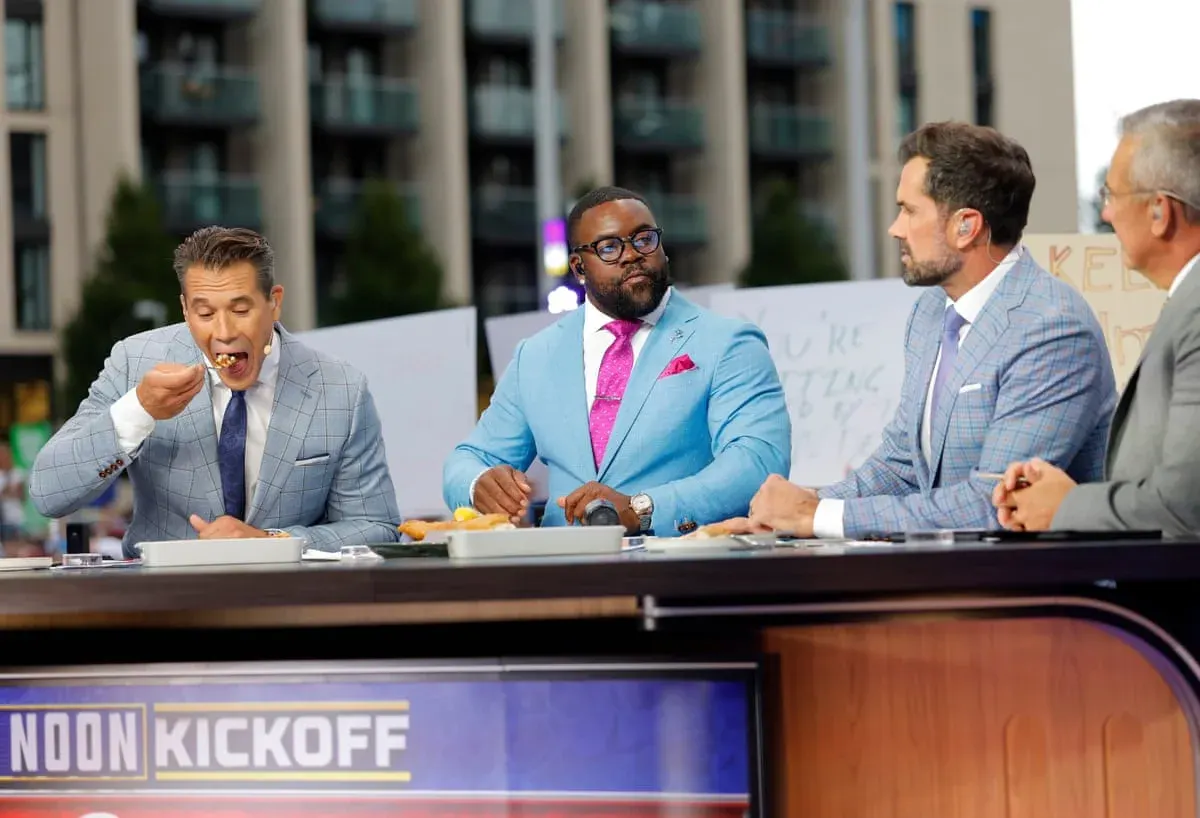
FOX set up on Wembley Way with a fake Grenadier guard and an old red phone box while Urban Meyer, Brady Quinn, Matt Leinart and Mark Ingram ate fish and chips on television. This happened in London, a city where actual guards, actual red phone boxes and actual fish and chips were already available in meaningful quantities.
There is something almost spiritual about traveling 4,000 miles to experience another country and immediately constructing a themed replica of that country beside your own television set.
Hello, England. We have traveled all this way to learn about your fascinating culture. Please stand beside this red phone booth we brought.
The Union Jack Classic was billed as the first top-tier college football game on British soil, but by kickoff it had become something closer to a controlled detonation of American cultural material. Arizona State and Kansas ran onto the field through fireworks. Paige Blake played the American national anthem on electric guitar. Cheerleaders performed during stoppages. Marching bands filled the stadium. Every available silence was identified and eliminated.
One of the event's organizers described the blueprint as "a concert with an American football game stuck in the middle."
This is an extraordinary sentence because it suggests someone briefly considered the possibility that the football game might be the main attraction and then corrected the error.
For centuries, Britain traveled around the world exporting its institutions, ceremonies and peculiar confidence that everybody else might benefit from becoming slightly more British. Two hundred fifty years after one of its more expensive customers canceled the subscription, America has returned with a counteroffer.
The East India Company had spices. The Big 12 has media rights.
The operation was not subtle. Kansas supporters brought Rock Chalk. Arizona State supporters brought Forks Up. The two schools brought their bands. The broadcasters brought the fake guard. The production brought the electric guitar. Organizers brought enough music and spectacle that Wembley groundstaff were reportedly left with a cleanup problem before England's next soccer match.
This is what makes the whole thing feel less like cultural exchange than reverse imperialism conducted by people with credential lanyards.
We did not ask Britain to become America. That would have been impolite.
We simply arrived, filled Wembley with as much America as the fire code would permit, recreated Britain for decorative purposes and announced plans to return next year.
Even the sightseeing carried the same energy. Many of the players had never left the United States before. They toured the Thames and Tower Bridge, posed in front of Parliament and absorbed several centuries of imperial history before heading back to a stadium where an American anthem would shortly be played on electric guitar.
Then Arizona State won 24–17.
Naturally, they were awarded Tower Bridge.
Not access to Tower Bridge. Not a tasteful plaque depicting Tower Bridge. The winner's trophy was a heavy model of Tower Bridge, because apparently once America visits an internationally significant landmark we are entitled to take home the miniature version.
Conquest rarely comes with this much licensed merchandise.
The Big 12 commissioner has been explicit that this is supposed to continue. The conference wants a global footprint. Organizers are already talking about returning to Wembley with two new teams next year. The British Empire once boasted that the sun never set on its territory. The Big 12 appears to have looked at the map and concluded there were still underpenetrated media markets.
This is not isolationism. This is franchising.
America's most durable foreign-policy instinct may simply be believing that somewhere, on another continent, there is a perfectly good piece of real estate that would benefit from a marching band.
And so the first great American college-football landing in London ended exactly as it should have: 46,000 people in Wembley, 15,000 Americans in the traveling party, Arizona State holding a small metal bridge, and the people responsible saying this was only the beginning.
The British once spent centuries exporting versions of Britain to the rest of the world.
We have now repaid the favor by arriving in London and building Britain back to them out of props, fish and chips, fireworks and a Big 12 media package.
Manifest Destiny has reached the Jubilee Line.
Mind the gap.
 Brief
The Comments
0 ON THE RECORDPredictions and premature victory laps may inspire future coverage.