
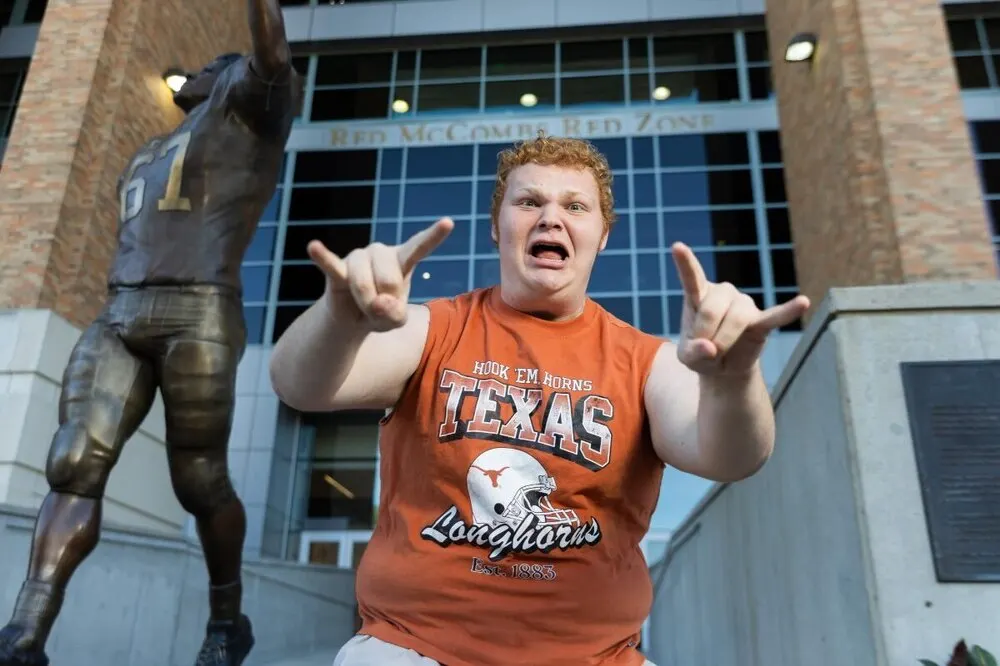
Preston Powe did not move to Los Angeles. He did not spend six years bussing tables while an acting teacher named Stefan explained that his problem was that he was indicating sadness. He did not perform an emotionally vulnerable monologue from This Is Our Youth in a fluorescent room for three assistants eating Sweetgreen.
He went to a Texas football game.
Powe, a 20-year-old University of Texas acting student better known around Austin as “Big Red,” became a minor internet celebrity the old-fashioned modern way: by appearing on the stadium video board and behaving like someone whose family had been informed that shirts were a federal conspiracy.
He lip-synced, screamed, ripped his shirt off, became a fixture at Longhorn games, and eventually became recognizable enough that talent people noticed. This week, he appeared in Brothers, the new Apple TV comedy starring Matthew McConaughey and Woody Harrelson, playing a character identified as a “Crazy College Kid.”
That is magnificent, not merely because Powe achieved his first television role by demonstrating that he could convincingly portray the sort of person he already was during third quarters, but because somewhere between Powe removing his shirt and Apple issuing a call sheet, the American entertainment industry completed a transition so profound that nobody bothered announcing it.
The audition had already happened. Nobody had called it one.
For most of the previous century, popular culture flowed through a reasonably legible series of gates. You wanted to act, you found an audition. You wanted to make music, somebody at a label eventually had to hear you. You wanted to become a television personality, a producer first had to become convinced that other humans might enjoy looking at you.
There were agents, casting directors, scouts, editors, talent departments, development executives and other highly compensated mammals whose job was essentially to stand between the anonymous public and the enormous glowing rectangle and say: you, not you, you, maybe you if you lose ten pounds.
This system was frequently cruel, exclusionary, esoteric and inefficient. It also had one important characteristic: you generally knew when you were auditioning.
That distinction no longer exists. We have replaced the casting room with the world.
Every football game is a screen test. Every wedding is a content shoot. Every public meltdown is a pilot episode. Every attractive person buying tomatoes at Whole Foods is potentially three TikToks away from acquiring management.
A civilian enters the frame, the internet responds, the algorithm measures the response, and someone with money notices the measurement.
Now we manufacture stars accidentally and Hollywood shops the clearance rack.
This is usually described as democratization, which is not entirely wrong. The old gatekeepers genuinely have less power. A person can become culturally relevant without first convincing a studio executive that their face possesses the correct kind of cheekbones. Musicians can build audiences before labels arrive. Comedians can become famous without getting the 11:40 p.m. slot at the Comedy Cellar. Actors can be discovered because several million strangers saw them doing something extremely stupid behind Rece Davis.
There is something wonderful about that. There is also something completely deranged about the machinery required to make it possible, because the democratization of fame required the industrialization of observation.
The old system occasionally watched people who had asked to be watched. The new system watches everybody.
We all understand this now at an almost cellular level. There may be a camera. There probably is a camera. If there is not a camera, another person nearby possesses a device containing several cameras.
The strange thing is not that people consciously perform for them. Plenty do, obviously, and God has punished these people by making them influencers. The stranger thing is that even when we are not performing, we live with the knowledge that performance is possible.
A funny reaction could travel. An embarrassing one could travel farther. The drunk guy asleep at the baseball game might wake up as an account with 80,000 followers. The woman screaming during a street interview might become a meme. The college kid losing his mind at a football game might someday hear Matthew McConaughey say, essentially, hey, aren’t you the guy from the thing?
The camera is weather.
It is simply part of the atmospheric condition in which public life occurs. And once everybody grows up underneath that weather, it becomes very difficult to know where authentic behavior ends and performance begins.
This is not necessarily because everyone is fake now. That explanation is too easy. People have always performed socially. We dress differently at weddings than we do while unclogging a toilet. We tell stories differently when attractive people are listening. A nineteenth-century gentleman entering a salon was no less aware of his audience than a college sophomore entering a tailgate.
What changed is the potential size and permanence of the audience. The salon ended when you went home. TikTok does not.
A human being can now execute one especially compelling facial expression at 2:16 on a Saturday afternoon and discover Tuesday morning that it has acquired a soundtrack, a nickname and merchandising opportunities.
Andy Warhol predicted fifteen minutes of fame. He severely underestimated the efficiency gains of vertical video.
And this has scrambled the traditional relationship between cultural institutions and the public. Hollywood once created stars and then introduced them to America. Now America frequently creates stars and sends Hollywood the analytics.
Powe’s route from stadium character to television actor is charming partly because it makes the machinery so visible. Student attends football game. Student behaves memorably. Camera finds student. Crowd rewards student. Internet distributes student. Student becomes recognizable. Recognizability acquires economic value. Entertainment industry purchases recognizable person.
This is not dramatically different from an audition. It is simply an audition administered by several hundred thousand strangers with no HR department.
There is something beautifully circular about Powe being an acting major. He is, by all accounts, actually trying to become an actor. He just appears to have enrolled simultaneously in two acting programs: one charges tuition, and the other seats 100,000 people and serves beer.
Juilliard once represented an almost priestly idea of artistic development: disappear into an institution, study the craft, become technically proficient, and eventually emerge prepared to be seen by the public.
The internet inverted the order. Now you are seen first. Training may occur later. The public conducts the entrance examination before the school does.
Maybe you’re a comedian because people laughed. Maybe you’re a singer because people shared the song. Maybe you’re an actor because an algorithm discovered that strangers enjoyed your face. The credential follows the attention.
Powe, for what it’s worth, seems almost suspiciously wholesome about the whole thing. He told reporters he loves Texas, loves performing and wants to make people happy. His new show is itself an elaborate collision between reality and fiction: McConaughey and Harrelson play versions of themselves while exploring the real-life rumor that they might actually be related.
So Powe has entered television through the exact door television currently prefers: already halfway fictional.
A real college student became an internet character and was hired to play a fictional college character inside a television show where real movie stars play fictional versions of their real selves based on a real rumor about their real lives.
This is no longer a snake eating its tail. The snake has a development deal.
And maybe that is where entertainment was always heading: not toward some grand distinction between real life and media, but toward the complete collapse of the border between them.
The audience becomes the cast. The cast plays itself. The public watches the performance and generates the next cast. The whole country becomes simultaneously theater, focus group and casting office.
Which means the next movie star may currently be at a bar, or a wedding, or sitting behind home plate, or attending a college football game while completely unaware that somewhere, in a control room, a camera operator is deciding whether to put his face on a 134-foot screen.
He does not know it yet. But his audition has started.
 Brief
The Comments
0 ON THE RECORDPredictions and premature victory laps may inspire future coverage.