
There is a moment in every great artistic movement when individual expression gives way to something larger. The scattered impulses of several creative minds become a shared language. An aesthetic emerges. A school is born.
On Sunday afternoon in Detroit, this process took approximately four seconds.
The resulting work, performed by the Detroit Lions in the closing minutes of their victory over Green Bay, deserves careful study. It is a remarkable examination of human cooperation, artistic evolution, and the delicate relationship between spontaneous movement and practiced choreography.
It also features Jameson Williams, who appears to have arrived at the exhibition with an entirely different assignment.
I. Genesis: The Gibbs Proposition
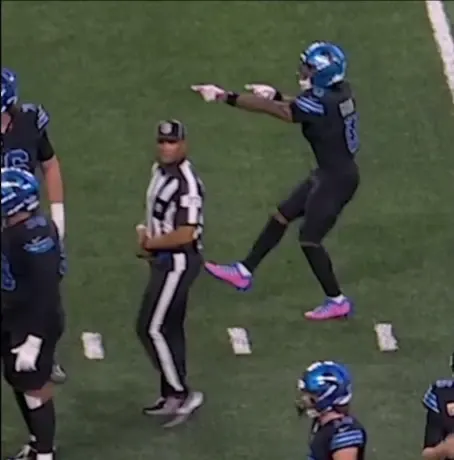
We begin with Jahmyr Gibbs.
His contribution is deceptively simple. A rhythmic movement of the feet, a degree of upper-body enthusiasm, the unmistakable confidence of a man introducing an idea he believes will be well received.
But it is what happens next that elevates this from celebration to art.
Gibbs looks toward his teammates.
This glance is fundamental to the work. In it, we witness the precise moment at which private expression becomes an invitation to collective creation.
Art historians have devoted entire careers to identifying the origins of major movements. Here, mercifully, we have video.
What follows is an extraordinary demonstration of cultural transmission.
II. The Formation of a School
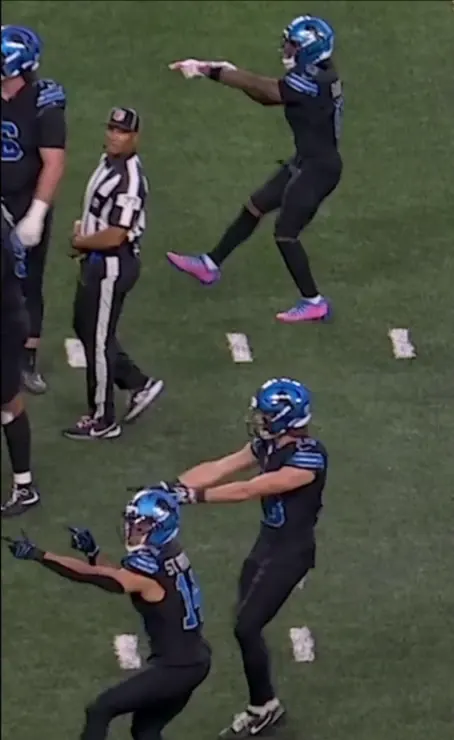
Amon-Ra St. Brown and Isaac TeSlaa recognize the invitation.
There is no visible instruction. No counting off. No consultation regarding tempo, preferred footwork, or the relative responsibilities of the participants.
And yet, within moments, three independently functioning adults have arrived at an almost perfectly coordinated routine.
The feet begin to agree. The arms discover a shared purpose. A glance becomes a movement, a movement becomes a sequence, and a sequence becomes choreography.
One is tempted to invoke the evolution of language. What begins as an isolated gesture acquires meaning through imitation, refinement, and repetition. Each participant contributes something without disrupting the integrity of the original idea.
The important thing is not that they are dancing together. It is that we can observe the very process by which together is invented.
There is also an extraordinary confidence to the execution. The performers behave as though they have rehearsed this sequence for several weeks, possibly under the supervision of a demanding woman named Renée.
It is impossible to determine how much was instinct and how much was preparation. That ambiguity is part of the achievement.
III. Jameson Williams and the Rejection of Consensus
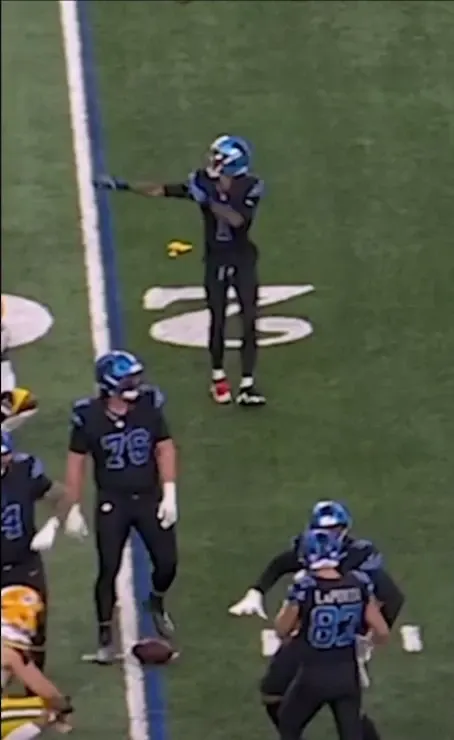
Every significant artistic movement eventually produces its dissidents. For the Detroit School, that figure is Jameson Williams.
While his colleagues develop an increasingly coherent movement vocabulary, Williams appears wholly uninterested in their findings. His arms swing independently. His timing bears little apparent relationship to the established rhythm. He inhabits the same physical space, but not necessarily the same artistic period.
This is not a failure of coordination. It is a rejection of the proposition that coordination is desirable.
Where Gibbs, St. Brown, and TeSlaa represent the emergence of collective consciousness, Williams challenges the very foundation of the movement. He is working in a different medium, possibly addressing a different audience, and there is little evidence that he considers either of these things a problem.
We might compare him to the modernists who rejected the conventions of the academy. We might invoke Dadaism, whose adherents questioned whether art required coherence at all.
Williams, one suspects, has never been particularly troubled by this debate.
There is something genuinely moving about a man so completely committed to an artistic vision that the simultaneous emergence of an entirely different choreographic movement three feet away does not warrant his attention.
He is not behind the beat. He has abolished the beat.
IV. Penei Sewell: The Monumental Tradition
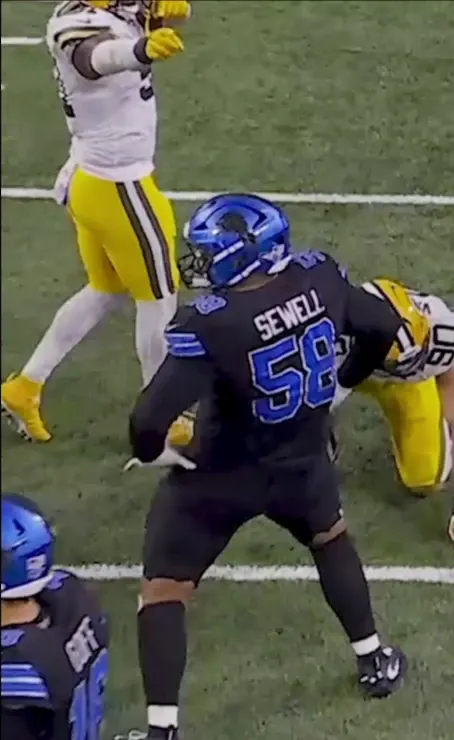
The composition now expands beyond dance.
Penei Sewell introduces a gesture of such force and conviction that it seems to belong to an older civilization.
His interpretation of the offsides signal is emphatic, almost ceremonial. There is no frivolity here. No interest in the delicate footwork developing elsewhere.
Sewell is working in monuments.
His physical vocabulary belongs to the tradition of public sculpture, where the body becomes a vehicle for authority, judgment, and the announcement of historical events.
There is something wonderfully disproportionate about the gesture. It possesses the gravity of a man declaring the succession of an emperor.
And yet its essential meaning is quite narrow: Green Bay has entered an area of the football field before the rules permitted it.
Sewell does not simply indicate the violation. He gives it a body, a mythology, a sense of consequence. His arms do not ask the officials for confirmation.
They appear to inform the universe that a transgression has occurred.
V. The Offensive Line and the Return to Vernacular Movement
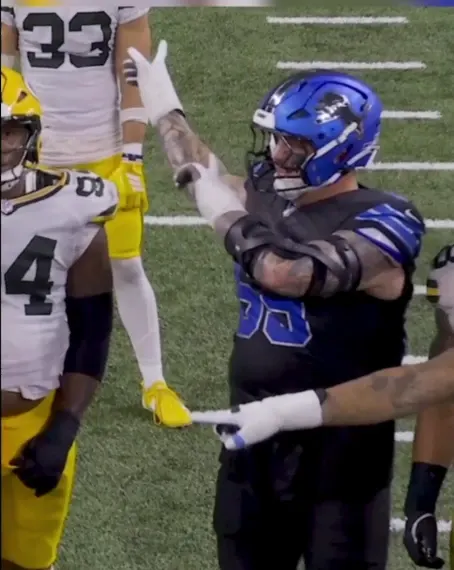
Elsewhere, the offensive line offers an entirely different interpretation.
Here the traditional first-down signal begins to mutate into something considerably more expressive. The pointed arms, the emphatic extensions, the rhythmic weight shifts: we find ourselves approaching the movement vocabulary of early-1990s hip-hop.
Cade Mays is particularly committed.
There is an appealing historical continuity to this development. The first-down gesture, originally conceived as a utilitarian communication of sporting progress, has been liberated from its administrative origins.
It is no longer simply a direction. It is choreography.
A practical symbol has become an aesthetic form, much as ordinary street movements found new meaning when incorporated into popular dance.
The football field has become a site of cultural reinterpretation. The officials supply the vocabulary; the players supply the grammar.
And the offensive line, perhaps sensing an opportunity to establish itself as an independent cultural institution, appears determined to contribute several paragraphs.
VI. Christian Mahogany: The Accusation
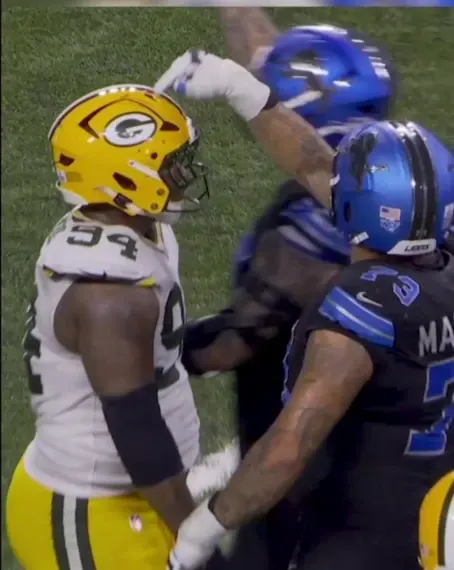
Then we arrive at Christian Mahogany.
While his colleagues concern themselves with rhythm, symbolism, and the evolution of collective movement, Mahogany has identified a more immediate subject.
Karl Brooks. The man responsible.
Mahogany approaches his subject and points directly at him, with the piercing conviction of an Old Testament prophet identifying the source of a community's misfortune.
This is an essential shift in the composition.
Until now, the work has been primarily abstract. Joy expressed through movement. Authority through gesture. Unity through synchronization.
Mahogany introduces narrative.
There is a protagonist. There is an accused party. There is now, unmistakably, a finger.
His contribution recalls the great traditions of European history painting, in which a single extended arm directs the viewer's attention toward the moral center of the scene.
The gesture is wonderfully intimate. Amid an expanding field of collective celebration, Mahogany feels compelled to seek out the responsible individual and ensure that he understands his historical significance.
Brooks has not merely committed a penalty. He has become the subject of a work of art.
Perhaps it is fitting that he should appear so close to the artist. The Renaissance masters enjoyed the patronage of the Medici family, whose financial contributions made entire artistic movements possible.
Brooks has achieved something similar, although probably not through a grant he intended to award.
VII. The Completed Composition
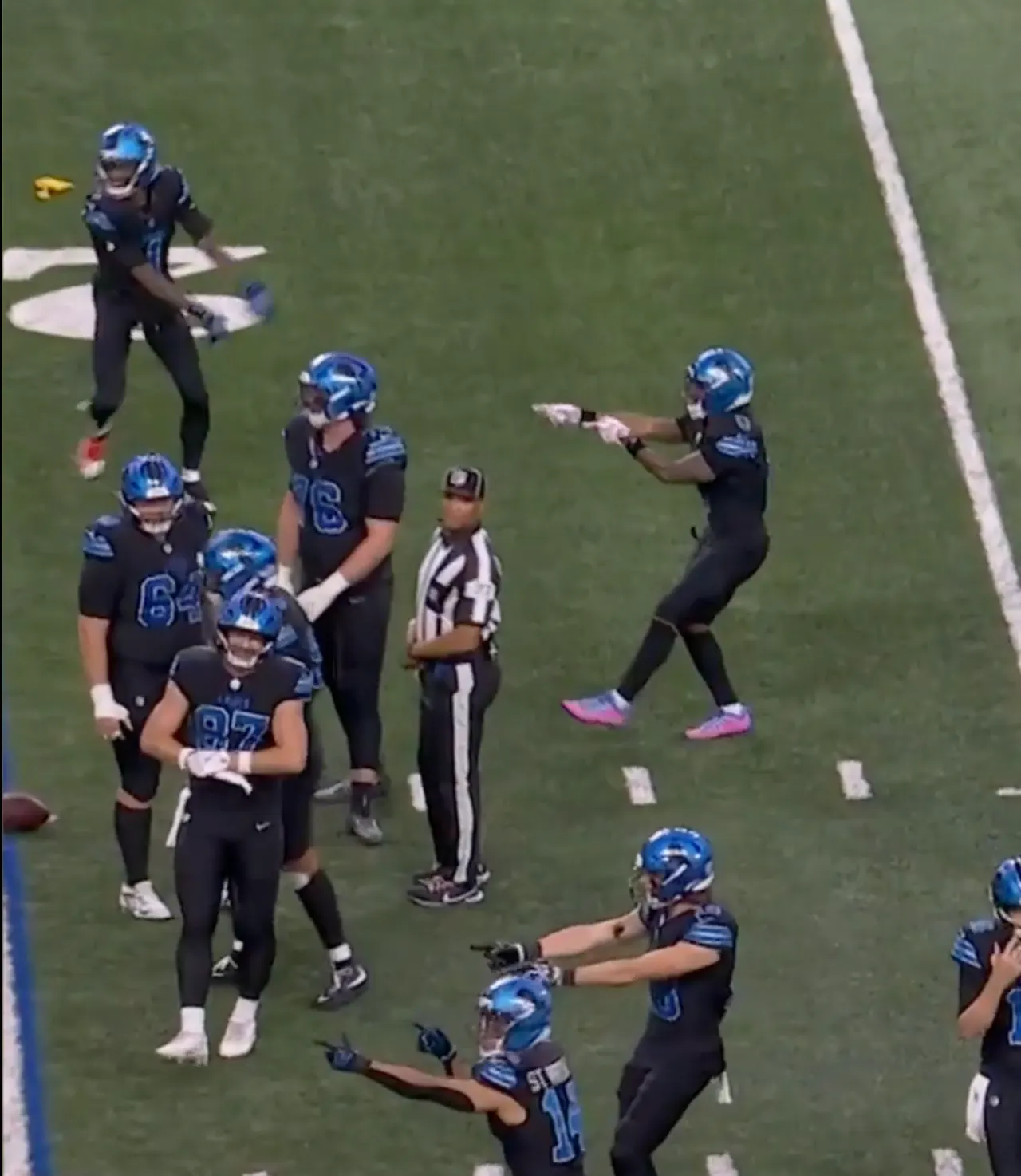
It is only when we return to the wider frame that the full significance of the work becomes apparent.
Gibbs, St. Brown, and TeSlaa have achieved choreographic unity. Williams appears to be dancing to music that has not yet been composed. Sewell has erected a monument. The offensive line has rediscovered hip-hop. Mahogany has identified a criminal.
These activities are occurring simultaneously. And somehow, they belong together.
What might initially appear chaotic reveals itself as a sophisticated study in complementary forms. Coordination and independence. Abstraction and narrative. Ceremony and improvisation.
The artists do not need to perform the same movement to participate in the same work. Indeed, the piece would be diminished if they did.
Williams's magnificent indifference makes the synchronization of the others more extraordinary. Sewell's monumental authority lends gravity to their frivolity. Mahogany provides a narrative anchor, reminding us that even the most abstract artistic expression can possess a very specific target.
The progression is astonishing: a solitary idea, an invitation, a coordinated response, a series of competing interpretations, and finally a complete composition.
There is no clear evidence that any of this has been rehearsed. There is considerable evidence that it should be again.
VIII. The Philistines
Naturally, there are people who watched Sunday's game and emerged primarily concerned with the officiating.
One respects the right of professional athletes to complain about the referees. It is one of the oldest surviving traditions in American sport.
But there is something rather depressing about encountering a flourishing new artistic movement and wishing to discuss the administration of the event at which it premiered.
Imagine attending the unveiling of Michelangelo's David and spending the afternoon disputing the municipal permit.
And then there is the possibility of intervention from the NFL itself.
The league has already demonstrated an impressive willingness to impose financial penalties on the artistic ambitions of Detroit's players. Earlier this season, several Lions were fined for celebrations, although Williams subsequently succeeded in having two of his penalties overturned.
One hopes the authorities recognize the significance of what has occurred here.
To penalize this performance would be an act of cultural vandalism.
The league has spent years encouraging athletes to display their personalities, and now an entire offense has collaborated on what may be the most ambitious expression of personality in recent sporting memory.
The correct institutional response is not a fine. It is an endowment.
IX. Legacy
The Detroit School may never produce another work of this quality.
Such is the nature of great artistic movements. They arise under extraordinary conditions, achieve a moment of remarkable coherence, and then disappear as quickly as they emerged.
The artists return to their lives. The audience returns to its own concerns. The moment passes into history.
But for those few seconds in Ford Field, something quite wonderful happened.
A man danced. Two others recognized the language and joined him. A fourth apparently heard a different song. Elsewhere, gestures became monuments, accusations became theater, and an offensive line briefly entertained the possibility of a second career.
What began as a single movement became a shared artistic language, acquiring followers, dissidents, and competing schools before anyone had thought to give it a name.
And then, as suddenly as it had begun, the movement dissolved. Its practitioners returned to their positions, its reluctant patron returned to the right side of the line of scrimmage, and the officials prepared to resume the game.
The Detroit School had flourished, fractured, and disappeared in less time than it takes to explain a neutral-zone infraction.
Most artistic movements require generations to accomplish this.
The Lions had a play clock.
 Brief
The Comments
0 ON THE RECORDPredictions and premature victory laps may inspire future coverage.