
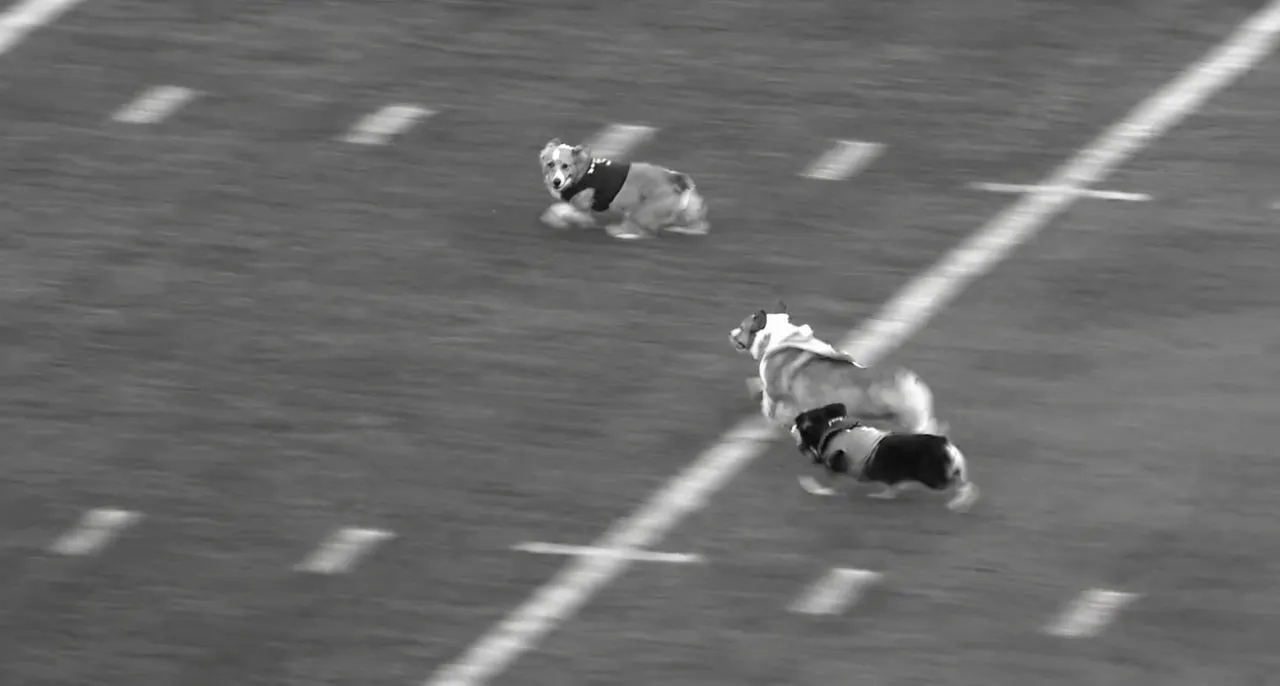
There is a photograph from the Seahawks’ corgi race that should be hung in every youth sports facility in America, then covered with a sheet whenever the children arrive.
In it, a corgi in navy has established enough separation from his competitors to turn his head and look back. Behind him, two other dogs are still engaged in the original activity: running as fast as their little legs will carry them. They have dressed for the occasion. They are making an effort. Somewhere nearby, people who love them are presumably saying their names.
The dog in front has decided to check on all that.
You can forgive speed. Some dogs are fast. You cannot account for every variable in a field of animals whose preparation may include eating a receipt. What requires explanation is the discretionary use of the neck. Every fraction of a second spent looking backward is a fraction of a second this animal believes he can afford. He has reviewed the competition and incorporated sightseeing into his race plan.
There is a Usain Bolt quality to the image, except Bolt had the decency to possess legs. This is a throw pillow with access to a higher gear. His undercarriage is practically brushing the venue, and he has still found time to turn around like a man who has just said something unforgivable at a dinner party and wants to see whether it landed.
We have spent too long assuming that being shaped like this precludes malice. Put a corgi in a little jersey and people immediately begin speaking in a voice they would be embarrassed to have played back in court. Who’s a little athlete? Who’s a speedy boy? Meanwhile, the speedy boy is managing the psychological decline of two colleagues on an NFL field.
Consider the social contract under which the other dogs entered this event. A car ride. Some excitement. A brief athletic obligation, followed by extravagant praise. Nobody explained that they might become supporting characters in another corgi’s Jordan documentary. Their owners signed up for enrichment. They are leaving with film to study.
And now they have to go home together.
That is the part the highlight economy never considers. The losing corgi still has to sit in the back seat while someone up front says, “You did so good,” with the strained brightness of a parent leaving a disastrous school production. The dog does not know what a participation trophy is, but he knows the car is quieter than it was on the way there. At a red light, his owner watches the clip again.
The winner, meanwhile, will be impossible at the dog park. You cannot return an animal to ordinary society after he has discovered that his physical gifts come with a broadcast angle. A tennis ball will no longer be enough. He will need the tennis ball thrown in front of people whose opinion matters to him. Fetch will require a media availability.
Naturally, there are questions about the program. Everyone else appears to have brought a pet. Somebody brought a system. I am not accusing this dog of anything, but I would like to understand his relationship with the person who measures his food. We are being asked to accept that this level of separation is available through ordinary kibble and a supportive home environment, and I think the sport deserves a more rigorous conversation.
Still, the legs are only part of the story. The photograph is worth keeping because it catches the moment a wholesome halftime diversion acquires an author. Until that glance, the trailing dogs are simply losing a race. Once he looks back, he is watching them lose it.
Print it wide. Keep the other two in the frame. The empty turf between them is essential to the composition, as is the terrible sincerity of their pursuit. They are still giving everything. He has enough left over to take an interest.
Tonight, all three will be told they are good boys. Two will need to hear it.
 Brief
The Comments
0 ON THE RECORDPredictions and premature victory laps may inspire future coverage.