
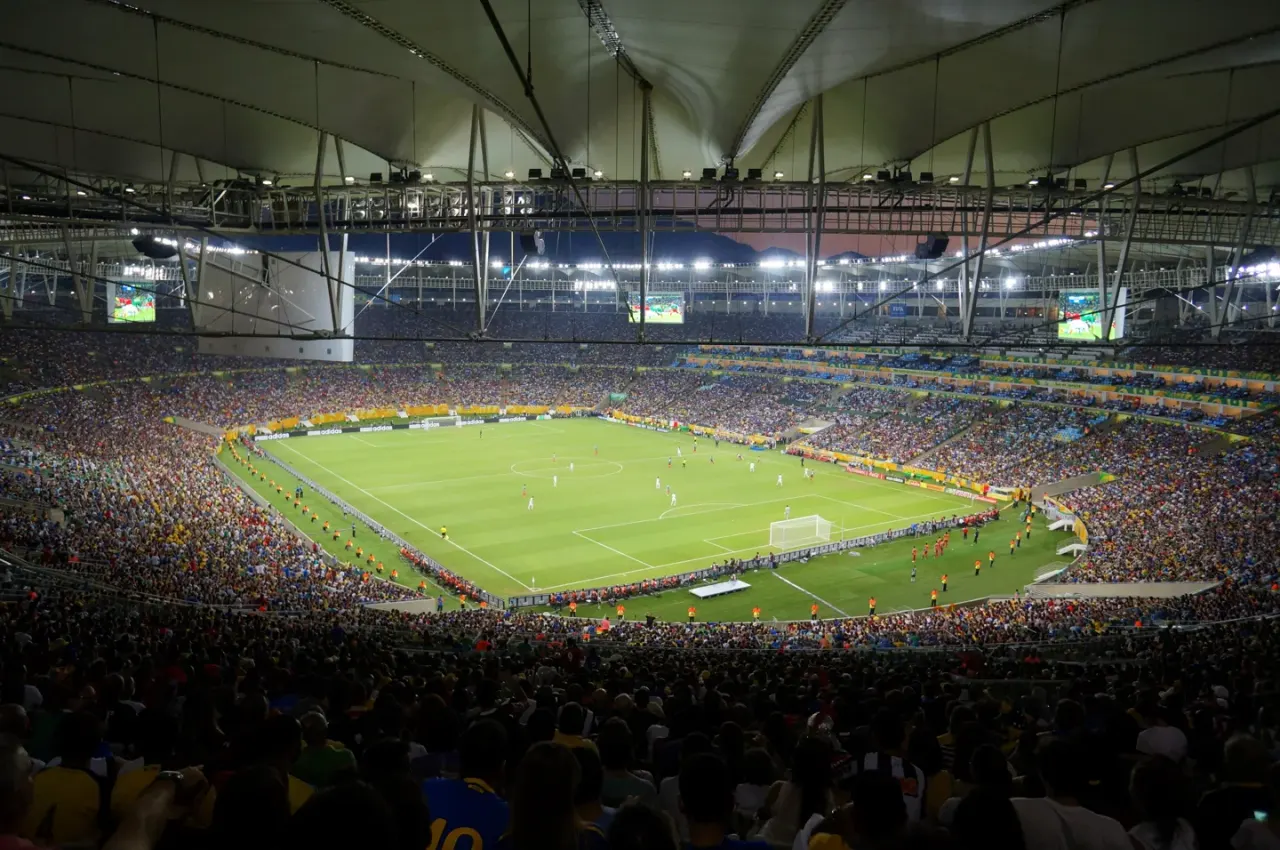
RIO DE JANEIRO — There are buildings that belong to whoever owns them, and then there are buildings that have been around long enough to develop more complicated arrangements.
The Maracanã is the latter.
On Sunday afternoon, the Baltimore Ravens and Dallas Cowboys will play the first NFL game ever staged in Rio de Janeiro. The league has spent the preceding week doing what leagues do when arriving somewhere important: installing signage, producing merchandise, arranging appearances, displaying the Lombardi Trophy and all 60 Super Bowl rings, and generally behaving as though a city has been waiting patiently for its activation calendar.
Rio, characteristically, had other things going on.
The grass is bad.
This is not metaphor. Not yet.
The Maracanã pitch has been criticized for months, including publicly by Flamengo and Fluminense players. Repairs were carried out in August. More repairs were planned in September specifically around the NFL game. The stadium hosted 73 matches in 2025, and its administration says the volume of use, combined with weather, has left the field under constant strain.
A full replacement is planned for the end of the year.
Until then, everyone would still quite like to use it.
This is where the Maracanã becomes more interesting than Ravens-Cowboys.
Flamengo and Fluminense administer the stadium under a long-term concession from the state of Rio de Janeiro. Vasco da Gama would also like access to it. Its supporters spent part of this week hanging protest banners around Rio after the stadium’s operators rejected a request to host one of Vasco’s matches, citing, among other things, the condition of the grass.
The complaint was wonderfully simple: respect the rules. Vasco supporters argued that the concession requires equal treatment among Rio’s major clubs and prioritizes official football matches. Flamengo and Fluminense maintain that Vasco’s access is limited and subject to availability and technical conditions.
And now the Dallas Cowboys are coming.
There is something almost elegant about this.
Vasco cannot have the Maracanã because the field requires protection.
The NFL can have the Maracanã while emergency repairs are being discussed to make the field suitable for the NFL.
I do not offer this as evidence of conspiracy. Conspiracies generally require considerably more organization.
It is simply what happens to important places.
Everyone develops a very persuasive reason why his particular use of them should take precedence.
The Maracanã has spent most of its life being subjected to this kind of possessive grammar. My club. Our stadium. Their concession. The people’s ground. Brazil’s temple. Rio’s monument.
The nouns change. The claim does not.
Even ownership here is unusually theatrical.
The stadium belongs to the state. Flamengo and Fluminense hold the concession to operate it. Vasco has negotiated limited access while objecting when that access proves, in practice, limited.
This is less a property arrangement than a family WhatsApp group with lawyers.
And yet Sunday will look extraordinarily simple.
The Cowboys will be designated the home team. Baltimore and Dallas will enter the stadium. The NFL shield will appear everywhere it is contractually capable of appearing. The game will kick off at 5:25 in the afternoon local time. Ricky Martin and Pedro Sampaio are scheduled for halftime.
For approximately three hours, the building will acquire a temporary identity.
This happens frequently at famous places.
Wembley can become an NFL stadium. The Foro Italico can become a concert venue. The Grand Palais can become a fencing hall. A sufficiently desirable building eventually stops having one function and becomes something closer to cultural real estate.
The mistake is assuming this makes the place neutral.
It does the opposite.
Every new occupant arrives because of everything that happened there before him.
The NFL did not choose an anonymous 78,000-seat stadium in Rio. It chose the Maracanã.
That name arrives with its own weather system.
Two World Cup finals. The 2016 Olympic ceremonies. Flamengo. Fluminense. Vasco. Brazil. Uruguay. Pelé. Ghiggia. Generations of Cariocas with stories about particular sections, particular nights and particular ways home.
You cannot rent that history.
You can only rent the building underneath it.
This distinction tends to become clearer when someone new arrives.
There will be NFL fans in the stands Sunday. Many will be Brazilian. Some will have followed the Cowboys or Ravens for years. American football in Brazil does not require the audience to be explained into existence; the league has already played two regular-season games in São Paulo and returned because there is, quite plainly, a market. Rio is the new city, not Brazil the new country.
So this need not be framed as a visitation from a foreign civilization.
Rio has seen foreigners.
It survived Madonna.
The more interesting spectacle is watching an institution as confident as the NFL enter a place whose identity is even more secure.
American professional football is accustomed to transforming buildings around itself. Stadium clocks change. Advertising changes. Locker rooms change. Field markings change. A place is made legible to the league.
The Maracanã is unlikely to become legible quite so easily.
Its disputes will still be there Monday.
Flamengo will still believe it requires the building. Fluminense will still possess contractual rights inside it. Vasco supporters will still have opinions about equitable access. The state will still own it. And the grass, barring an unexpected spiritual recovery during the fourth quarter, will still need replacing.
This may be the Maracanã’s defining quality.
It accommodates everybody without quite surrendering to anyone.
The more people claim it, the less convincing any single claim becomes.
Perhaps that is why the condition of the field feels so wonderfully appropriate.
A stadium can absorb mythology more easily than it can absorb usage.
There is a limit to how many matches can be scheduled, how many events can be sold, how many institutions can announce that their need is exceptional.
Eventually the abstraction becomes physical.
The turf tears.
The seams show.
Someone has to stop talking about heritage and get the groundskeeper.
On Sunday, Lamar Jackson may scramble across it. Dak Prescott may throw touchdowns over it. Derrick Henry may introduce portions of it to the basic principles of force.
Millions of people will watch.
And for one afternoon the NFL will have the Maracanã entirely to itself.
Which is about as long as anyone ever does.
 Brief
The Comments
0 ON THE RECORDPredictions and premature victory laps may inspire future coverage.