
By the end of Sunday’s game, the assignment had become quite manageable. Nobody needed to split a safety, beat a double-team or make an exceptional throw. Washington needed to stop the clock and attempt a field goal. These are separate operations, but NFL teams generally train for both.
The Commanders completed neither. Their 27–27 tie with the Giants ended at New York’s 24-yard line, with a potential winning kick left unattempted. There are ties in which two evenly matched teams exhaust their resources. This one felt like two people holding a door open for each other until the building closed.
What makes the ending remarkable is the level of difficulty of everything that preceded it. Returning from his elbow injury, Jayden Daniels accounted for 302 yards and two touchdowns. Washington built a 14-point fourth-quarter lead. Jameis Winston then completed 10 of his final 13 passes in regulation and threw two touchdowns to bring New York back. Both teams had demonstrated that they could perform complicated football tasks under considerable physical duress. Asking one of them to conclude the event turned out to be an unreasonable escalation.
The Giants contributed generously. Dominic Zvada missed three field goals, and Cam Skattebo fumbled in overtime with New York in position for a winning kick. This was a substantial body of work. In most games, it would have been sufficient to establish authorship of the collapse.
Washington felt there was more to explore.
After taking possession and moving into range, the Commanders arrived at the final seconds without a timeout. With roughly 12 seconds left, they ran another play. Daniels went down inbounds, and Washington could not get another snap off. The offense had successfully delivered the football to a place from which it could win, then remained with it until the offer expired.
This deserves its own category of late-game failure. A missed kick at least involves an attempt to resolve the contest. A fumble requires an opponent, contact, an identifiable physical event. Washington produced an outcome for which the defense’s most important remaining contribution was to respect the passage of time.
The Commanders were still shopping for a better field goal as the one they already had expired. It was the football equivalent of missing a flight while negotiating an upgrade at the gate, except the gate was visible to the entire coaching staff and several million people were pointing at it.
There is a particular coaching vanity in trying to improve a situation that mostly requires being left alone. Another adjustment, another few yards, one more advantage extracted before permitting the ordinary thing to happen. Washington had reached the part of the afternoon that called for a kicker and decided to keep workshopping.
Quinn acknowledged afterward that the additional yardage was unnecessary and accepted responsibility for the sequence. The eventual film review should be unusually accessible. No need to identify a disguised pressure or determine which receiver converted his route incorrectly. Put the clock in one corner of the screen and the timeout count in the other. The entire room can watch the organization run out of both ideas and seconds while retaining possession of the football.
Skattebo, meanwhile, had received an extraordinary professional courtesy. His overtime fumble remained on the record, but Washington had volunteered to handle the public-facing portion of the disaster. It is rare for a divisional opponent to provide crisis communications this quickly.
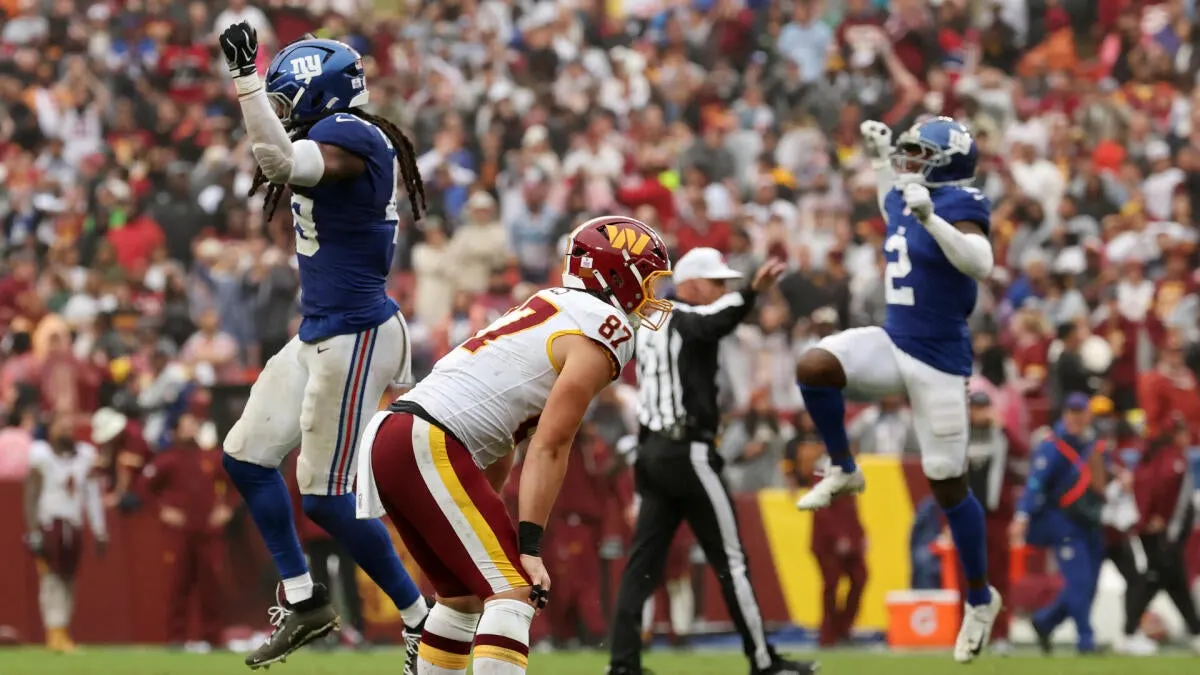
At the finish, Giants defenders celebrated while Quinn threw his headset to the ground. The identical score concealed two very different experiences. New York had escaped a building it helped set on fire. Washington was still inside explaining that it wanted a slightly better exit.
Eventually, someone will win the NFC East. The league has made that mandatory.
 Brief
The Comments
0 ON THE RECORDPredictions and premature victory laps may inspire future coverage.