
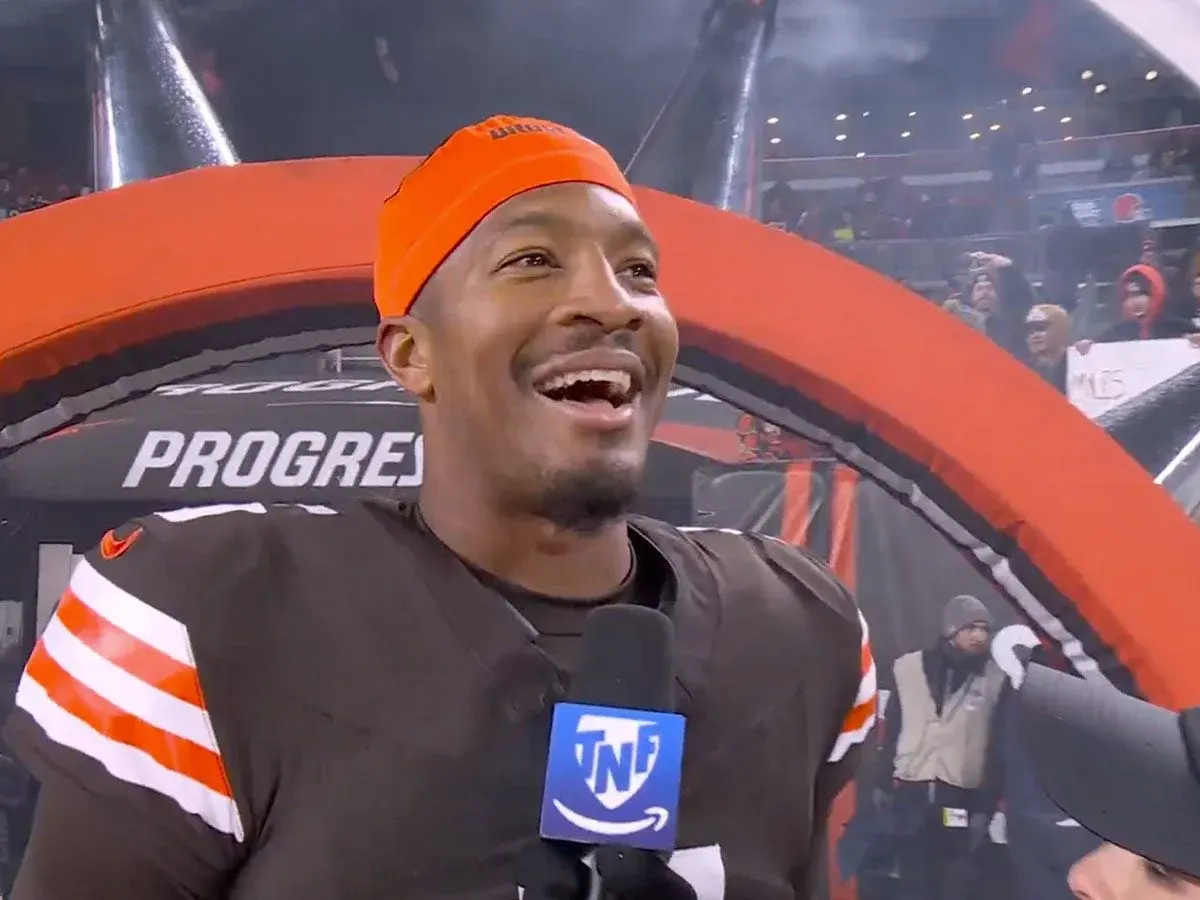
Jameis Winston was asked a fairly ordinary question on Sunday morning.
How confident was he, carrying the Giants forward?
“One thing that I do is forgetting those that is behind, and reaching forward to what’s ahead,” he said.
Then he stopped talking.
There is a particular look Winston has after he has finished saying something. His eyes widen slightly. His chin settles. Usually he smiles. Then he looks past the reporter and into a middle distance unavailable to the rest of us.
Somewhere only Jameis can go.
It is an almost perfectly constructed Jameis Winston sentence. There is movement. There is philosophy. There is temporal orientation. There is a past, a future and an implied moral responsibility to travel correctly between them.
There is no answer to the question whatsoever.
This is advanced work.
Most athletes evade questions by saying one game at a time. Jameis has discovered that you can evade the question more elegantly by making the reporter briefly wonder whether time itself is linear.
The draw to Jameis Winston is that his actual personality remains strangely elusive despite a decade spent expressing it at maximum volume. The more evidence he provides, the harder he becomes to explain.
So I went back through the archive.
The easiest reading of Jameis is that he is an incredibly reliable sound-bite factory.
This is inadequate.
Jameis occasionally constructs a sentence that sounds as though it has been translated from English into prophecy and then back into English.
In 2022, playing quarterback for the Saints with multiple back fractures, Winston was asked where he was experiencing pain.
“Just pain,” he said.
A pause.
“It was pain, everywhere.”
A person whose body hurts in many locations has described his body hurting in many locations. And yet pain, everywhere is somehow much funnier and much more complete than any medically useful response could have been.
The reporter asked for geography.
Jameis provided the human condition.
Two years later, before the Browns played the Steelers in a wintry mix, a reporter asked Winston what it would take that night.
Naturally, he arrived at Proverbs 21:31. His expression was completely serious, the answer delivered with the solemnity of a surgeon explaining what happens next:
“The horse is prepared for battle, but victory comes from the Lord.”
Then came the weather question.
The same Lord whose omnipotence would predestine the battle had apparently also blessed Jameis with snow and “true football weather.”
His entire disposition changed. He looked like a mastiff puppy discovering that snow for the first time.
Both Jameises were completely sincere.
The Browns won 24–19.
This did not prove Winston correct. It made disproving him considerably harder.
There is also the earlier theorem:
I’m strong if you strong.
We strong, then.
Winston’s strength depends upon the strength of the group. The group’s strength is confirmed by Winston’s strength. Therefore, we strong.
It is a closed motivational system. No external evidence can penetrate it.
Descartes needed a treatise. Jameis needed seven words.
The archive kept producing these, and eventually I stopped asking whether individual statements made sense. I started asking why they felt like they did.
Any serious scholarship must eventually confront Eat a W.
In 2017, Winston stood before his Tampa Bay teammates and attempted to transform winning from an abstract competitive outcome into something edible. He formed his fingers into a W.
Then he ate it.
The Buccaneers subsequently lost 30–10.
For most public figures, this would become a containment problem. You spend several years declining to discuss it. Your publicist asks podcast hosts not to bring it up. Eventually you describe yourself as young and say you’ve grown.
Jameis took another path.
He expanded the lore.
Years later, Peyton and Eli Manning asked him about the W. Winston did not retreat. He explained that the original technique had been flawed because of his mallet fingers. There was apparently a biomechanically superior method. The fingers should be arranged differently. One should “bite the nub.”
Most people eventually become embarrassed by the thing that made them an internet joke.
Jameis understood everyone was laughing and joined us with profound sincerity, while simultaneously adding it to his expanding portfolio of intellectual property.
This is where the investigation becomes difficult, because embarrassment or even subtle historical revision would tell us something. It would establish that there are two Jameises: the person who performed the act and the later person capable of observing the performance from outside himself.
Instead, the later Jameis walked back into the bit and began renovating.
Eat a W became crab legs became commercials became pregame sermons became ManningCast appearances became whatever increasingly interconnected body of work this is. Somewhere along the way, the Jameis Cinematic Universe had begun expanding around us. Nobody had announced Phase Two.
Then FOX sent him to the World Cup.
This may be the most consequential event in the archive, not because Jameis Winston demonstrated previously undiscovered expertise in international football; in fact, he leaned into the lack of it.
For years, Winston’s mercurial answers had produced a minor cottage industry devoted to interpreting Jameisese—figuring out what exactly had happened between the question entering his head and the answer coming back out.
And then FOX dropped him into a blender, surrounded by people who didn’t share his culture, often didn’t share his language, watching a sport whose nuances he freely admitted he was still learning.
And suddenly Jameis required almost no translation at all.
In Dallas, Winston boarded the Oranje Army bus with Dutch supporters. He marched with them toward the stadium in a sea of orange, microphone in hand, shouting about the Dutch Army as though he’d spent his childhood in Rotterdam.
Then the Netherlands played Japan, and afterward Winston changed constituencies.
Japanese supporters have a longstanding tradition of remaining in the stadium after matches to clean the stands. Winston put on a blue Japan shirt with WINSTON across the back, took a trash bag and joined them, moving through the rows collecting cups and wrappers.
Norwegian supporters taught him the Viking Row. Jameis appeared in a horned helmet and faux-fur wrap and began rowing.
Colombian supporters were dancing before a match in Miami. Jameis acquired a jersey and a wig and entered the dance.
He interviewed the parents of American defender Chris Richards about their son’s journey to the World Cup. It became a genuinely touching conversation about injury, perseverance and allowing a child to follow a dream his parents hadn’t chosen for him.
Then Jameis produced a rubber chicken.
They danced with it.
Before Argentina played Algeria, he arrived with an actual goat named Wesley wearing a Lionel Messi jersey. Jameis Winston had transported livestock to a World Cup match to make a visual pun.
The temptation is to call this performance.
But watch him with the Japanese supporters. Watch him with Richards’s parents. Watch how quickly strangers accept him.
Humor usually travels badly. Celebrity travels strangely. American-football celebrity should travel particularly badly at a tournament where the dominant opinion on which football has earned the unmodified name possesses a massive advantage in legacy and, you know, primary-appendage logic.
Jameis somehow crosses these borders almost frictionlessly.
He doesn’t explain himself.
He arrives as himself.
The environment adapts.
At the surface level, one might be inclined to assume Jameis Winston is trolling all of us.
The theory doesn’t survive much scrutiny.
Trolling requires too much distance. A troll knows where normal behavior is and intentionally steps outside it. The joke depends upon the performer maintaining some private separation between the person doing the ridiculous thing and the person who knows it is ridiculous.
Jameis appears to offer something more interesting.
The question isn’t whether he is performing. All public people perform. The question is whether Jameis Winston has achieved a form of self-awareness so complete that he no longer needs to modify the self being observed.
He knows how to Eat a W. He knows about the memes. He knows television wants Jameis because Jameis may do something television did not anticipate.
And his response to acquiring this information appears to have been:
continue being exactly the same person.
That’s sophisticated.
Perhaps accidentally.
Perhaps not.
Once performance, sincerity and self-awareness become this difficult to separate in a human being, the distinction takes on a whole new pattern of modern significance.
Because machines are trying to cross the same boundary from the opposite direction.
In 1950, Alan Turing proposed what became known as the imitation game. Rather than settle the abstract question of whether a machine could think, he proposed examining whether its responses could become sufficiently human such that an interrogator could no longer reliably distinguish machine from person.
It is a test about intelligence and self-awareness. Underneath it is the public-facing, existential problem: how do we recognize an authentic mind when all we are permitted to observe is its performance?
Recently, an AI-generated Jameis Winston clip circulated online.
The fake Winston purportedly told his Giants teammates that one man with one crab leg was mortal, but 53 men with crab legs become an unstoppable force.
It was fake.
People had to check.
At first this seems like another familiar story about synthetic media. Then you examine the control group.
Eating the letter W via his fingers?
Real.
Returning years later to explain the correct finger mechanics for eating said W?
Real.
Bringing an actual goat dressed as Lionel Messi to the World Cup?
Real.
Revisiting the crab-leg scandal for a DoorDash commercial by performing a reflex challenge with crab legs?
Real.
The machine has a considerable advantage.
Its training data is insane.
This creates what we might come to think of as the Jameis Winston Turing Test: can an artificial intelligence produce a statement attributed to Jameis Winston that is sufficiently strange to seem authentic without becoming so strange that even Jameis Winston would not plausibly have said it?
Perhaps Jameis himself doesn’t particularly care where that boundary is.
Artificial intelligence is forcing us into increasingly complicated arguments about authenticity. If a machine can perfectly imitate your voice, your face, your vocabulary and your mannerisms, what remains that makes the performance you?
We tend to answer with some version of interiority: intent, self-awareness, the private consciousness behind the performance.
Jameis complicates this because the external performance appears almost perfectly resistant to evidence about how that performance is perceived or originated.
The internet tells him he’s ridiculous. Jameis smiles. Television tells him he’s compelling. Jameis smiles. The meme gets repeated back to him. Jameis adds technical detail. A network drops him into an unfamiliar culture on the other side of the sporting world.
Jameis finds a trash bag.
The machine can imitate the output, but I’m not sure it can reproduce whatever internal arrangement makes that response feel inevitable.
Maybe that is the remaining distinction. Not intelligence, language or even originality.
Something irreducible and outside the boundaries of the algorithm: the capacity to remain genuinely unpredictable even after everyone thought they had the pattern.
I went back to the clip that started all of this.
Forgetting those that is behind.
Reaching forward to what’s ahead.
I had laughed the first time. After going through the archive, I watched it again.
Maybe the grammar isn’t the point.
The information definitely isn’t the point.
There is something radical about a person who has been shown, repeatedly and at enormous scale, exactly how the world perceives him and has apparently concluded that the appropriate response is not reinvention but greater fidelity.
That doesn’t make every Jameis sentence profound. Some of them contain absolutely nothing. That’s part of the problem, and part of the charm.
I still don’t know whether Jameis Winston knows exactly what he’s doing. I’m increasingly convinced that’s the wrong question.
He knows we’re watching. He knows why we’re watching. And somehow that knowledge has not made him more guarded, more calculated or less strange. More remarkably, it hasn’t made him predictable or tempted him into simply overplaying Jameis Winston for an audience.
Shakespeare had all the world as a stage. Jameis fired the editor.
Maybe that’s the test.
Maybe that’s the part the machine still can’t do.
The clip ends with Jameis gazing again into that truly unknowable middle distance.
For one brief moment, you can’t tell whether he’s just said something incredibly profound or absolutely nothing at all.
Then he smiles.
 Brief
The Comments
0 ON THE RECORDPredictions and premature victory laps may inspire future coverage.