
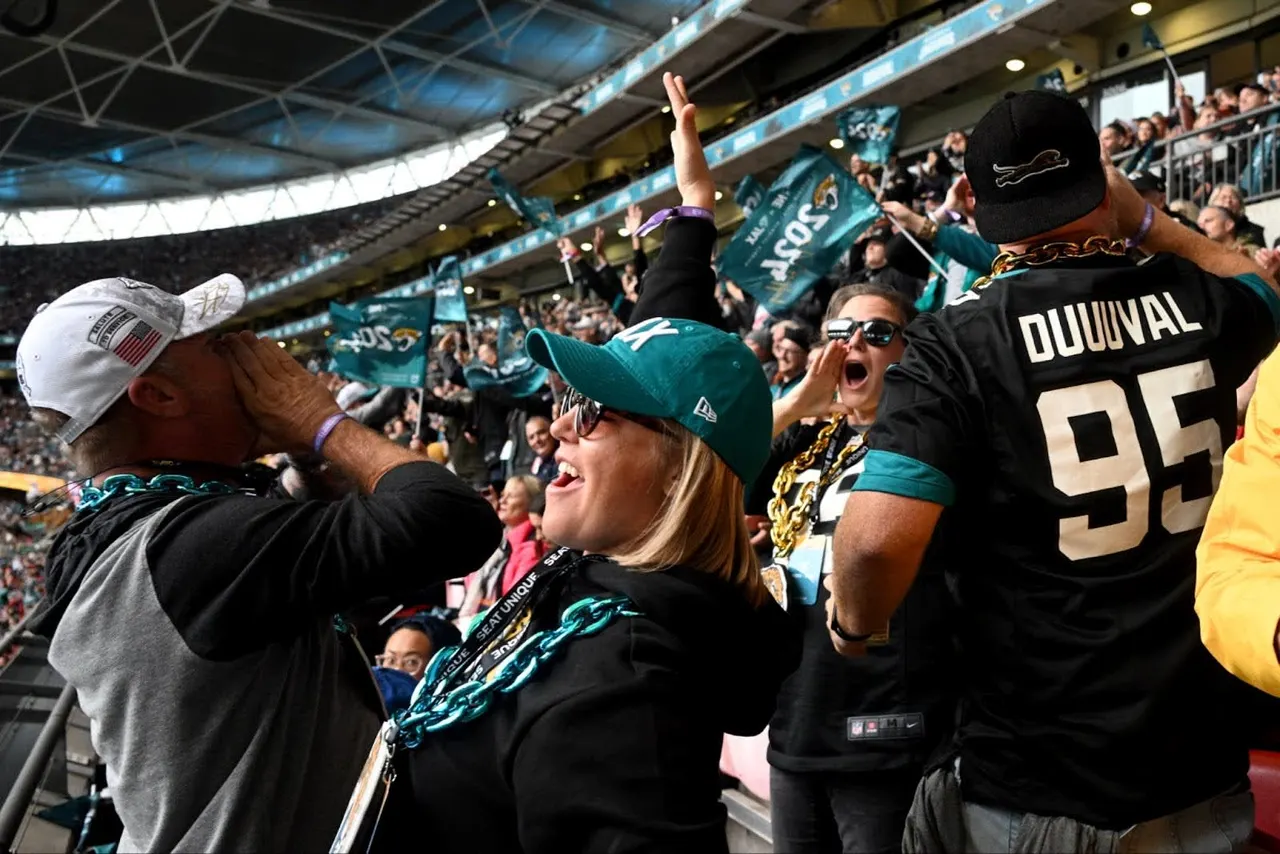
There are easier ways to build a global sports franchise.
You can begin in London, for instance.
You can be founded in 1882 by schoolboys from a cricket club, play your first matches on the Tottenham Marshes, spend the next 144 years accumulating trophies, enemies, songs, grievances and several generations of people who believe allegiance to you is less a consumer preference than an inherited medical condition.
Or you can begin in Jacksonville in 1993.
The National Football League awarded the city an expansion franchise on November 30 of that year. Twenty-one months later, the Jaguars played their first regular-season game. They had no ancestors to honor, no ancient ground to mourn, no grandfather who could explain what the club meant before television ruined it.
They had to make the rest themselves.
There were the unexpectedly excellent Mark Brunell teams, which reached two AFC Championship Games before the franchise was six years old. There was Fred Taylor. Maurice Jones-Drew. The stadium pools. Blake Bortles and the strange civic confidence required to believe in him.
Gardner Minshew arrived in aviators, a headband and a mustache that looked inherited from a regional contractor. Jacksonville did not merely tolerate him. It adopted him almost immediately. Minshew Mania became one of those rare sports phenomena that made perfect sense only after it happened: an overlooked sixth-round quarterback becoming a genuine folk hero for a young franchise still deciding what its folklore should look like.
The Jaguars have made history. They have simply had to make it faster and in stranger ways than everybody else.
Then there is London.
The Jaguars began playing an annual home game at Wembley in 2013. At first the arrangement carried the unmistakable smell of contingency. Jacksonville was one of the NFL’s smallest markets. London was the enormous foreign city the league had spent years staring at. The Jaguars were young, commercially ambitious and available.
The conclusion assembled itself.
Surely, they were leaving.
That conclusion has now survived long enough to become almost quaint.
The Jaguars have played 14 regular-season games in London since 2013. Eleven came at Wembley, three at Tottenham Hotspur Stadium. This season they will play two designated home games there on consecutive Sundays, first against Philadelphia at Tottenham on October 11 and then against Houston at Wembley on October 18. It is the third time the franchise has played back-to-back games in Britain.
There was a time when any one of those sentences would have generated another week of relocation stories.
Now it mostly generates travel information.
That may be the first strange thing worth noticing.
The second is that Jacksonville, after years of being treated as temporary, has committed itself rather aggressively to staying put.
The city and franchise are in the middle of a $1.4 billion stadium redevelopment backed by a 30-year lease and non-relocation agreement. Construction has reduced capacity this season to roughly 42,500, and the team will temporarily move its 2027 home schedule to Orlando before returning to the rebuilt stadium in 2028.
This is an unusual way to leave a city.
Shad Khan has spent years insisting he does not intend to.
In 2018 he attempted to buy Wembley Stadium, producing precisely the reaction anyone could have anticipated. Jaguars. Wembley. Owner buys stadium. Pack the moving vans.
Khan called Wembley the Jaguars’ “home away from home” and argued that strengthening the team in London would make its future in Jacksonville more secure.
At the time, that sounded like the sort of sentence corporate executives produce when two ideas are being asked to coexist against their natural instincts.
Eight years later, it has become difficult to dismiss.
The Jaguars are more anchored in Jacksonville than they have ever been. They are also more comfortable in London than they have ever been.
This year, because the Jacksonville stadium is operating at reduced capacity, the Jaguars moved forward an international-game obligation originally expected later in the decade. They sacrifice a smaller-capacity Jacksonville date now and recover a full-capacity home game once the new stadium is finished.
A football team has converted geography into inventory. Jacksonville is borrowing a home game from its own future, moving it across the Atlantic, using the absence to accelerate construction in Florida and planning to redeem the asset later in a more valuable building.
They are not merely playing in London anymore.
They are arbitraging it.
Tottenham Hotspur Stadium rises in North London on almost the same patch of earth where the football club began accumulating meaning in the nineteenth century.
Tottenham Hotspur is 144 years old. Its history can be measured in wars, monarchs, economic eras and arguments about Arsenal.
The Jacksonville Jaguars are 31.
Their first season occurred the same year Toy Story was released.
On Sunday, the Jaguars will walk into Tottenham Hotspur Stadium and be treated not as an American exhibition but as a home team.
Tottenham is one of the things old sports institutions aspire to become: inseparable from a place while recognizable nearly everywhere else.
Its stadium sits inside that history but was designed, rather ingeniously, not to be imprisoned by it.
The building has a retractable grass surface. Underneath it sits a separate field specifically for American football. It has NFL-specific locker rooms and media facilities. Tottenham and the NFL have extended their partnership through the 2029-30 season, guaranteeing at least two regular-season NFL games there each year and formally designating the stadium the “Home of the NFL in the UK.”
Daniel Levy has been straightforward about the logic: events create recurring revenue that can be reinvested into the football club.
That is particularly useful during seasons when the football club itself is less cooperative.
Tottenham opened the 2026 Premier League season disastrously. By late September, after an enormous squad rebuild, Spurs were winless, near the bottom of the table and enduring one of their worst starts of the Premier League era.
For the financial year ending June 2025, Tottenham reported £565.3 million in revenue and other income, citing sponsorship, merchandising and stadium events as commercial strengths even as poor football performance hurt media revenue. The club still recorded a £94.7 million after-tax loss.
The easy joke is that the Jaguars have somehow become the more functional football operation in Tottenham.
The better observation is that these organizations arrive at the same building from opposite ends of sporting history.
Tottenham has spent nearly a century and a half accumulating meaning until the club and the place became almost impossible to separate.
Jacksonville has spent three decades accumulating meaning while remaining unusually free to decide what comes next, and where.
That difference matters in London.
London is perhaps the worst possible city in which to argue that place no longer matters in sports. Its clubs carry neighborhoods in their names. Their rivalries are mapped onto rail lines, boroughs and old class boundaries. Supporters inherit allegiance in ways American franchises tend to describe aspirationally in marketing decks.
Into that environment comes Jacksonville: young, improvised, faintly renegade, successful enough to be taken seriously and still new enough to behave as though some of the old rules are negotiable.
England arrives as the old power: storied, established, heavy with accumulated prestige, and currently watching one of its great football institutions stumble through a miserable period.
Jacksonville arrives as the upstart: younger, less polished, less encumbered by tradition, and discovering that the lack of an old order can sometimes be its own advantage.
The colonies, after all, did not defeat Britain by possessing more history.
They had considerably less of it.
Tottenham’s identity is inherited. Jacksonville’s has been assembled in public, often awkwardly, sometimes brilliantly, from pieces that would have looked ridiculous in advance: Minshew Mania, pools in a football stadium, annual trips to Wembley, an owner who once tried to buy England’s national stadium.
Those things are not substitutes for history anymore.
They are Jaguars history.
And London has become part of it.
That is what makes the old relocation conversation increasingly unsatisfying.
For years the question was simple: Jacksonville or London? Florida or England? Stay or move?
But the Jaguars have spent more than a decade demonstrating that those choices may not be as mutually exclusive as everyone assumed.
Tottenham still makes the strongest possible case for the traditional model. Its value is bound up in the fact that Tottenham Hotspur could not plausibly become Tottenham Hotspur somewhere else.
Jacksonville is testing something much looser.
Not because Jacksonville means nothing. It clearly does not. There are now adults who grew up with the team, families whose Jaguars history spans generations, and a city investing heavily to keep it.
But thirty-one years is young enough that the franchise can still add geography without necessarily surrendering identity.
Pittsburgh could play an annual game in London. It would be difficult to make London part of what the Steelers are.
Green Bay could sell out Wembley tomorrow. Nobody would mistake Wembley for part of the Packers’ institutional geography.
The Jaguars have already crossed some quieter threshold.
London is no longer simply where Jacksonville plays sometimes.
It has become one of the places where Jacksonville happened.
That may remain unique to them. The peculiar combination of Khan, a young franchise, small-market economics, repeated games and more than a decade of institutional repetition may prove impossible to reproduce.
Or it may be exactly why the Jaguars matter.
The NFL has nine international games on the 2026 schedule across four continents, seven countries and eight stadiums. Teams hold international marketing rights. Fans follow franchises they may never see in their home cities. Stadiums increasingly operate as entertainment infrastructure with football attached rather than monuments devoted exclusively to one tenant.
Jacksonville did not arrive here through some immaculate master plan. Revenue pressures, league ambition, Khan’s appetite for London and the franchise’s own willingness to experiment all pushed in the same direction. What began as an accommodation kept being renewed until it developed traditions, constituencies and commercial logic of its own.
British Jaguars supporters came back. London stopped feeling temporary. The league built another stadium relationship. The annual oddity became part of the calendar. Eventually the arrangement became useful enough that Jacksonville could move a future game across an ocean because its stadium math worked better that way.
London now feels less like an exception the NFL tolerates and more like a piece of the schedule the league has learned to depend on.
Sunday offers a particularly elegant picture of what followed.
The stadium itself carries 144 years of inherited sporting memory. Into it walks a franchise with barely three decades of self-invented mythology, much of it assembled from unlikely quarterbacks, improbable playoff runs, London Sundays and decisions nobody else in the league quite had reason to make.
Tottenham demonstrates the almost incalculable value of belonging unmistakably to one place.
Jacksonville raises a different question:
What happens when belonging to one place no longer requires belonging only to it?
Perhaps the Jaguars remain a wonderful outlier — a peculiar franchise, an unusually international owner and a relationship with London that no other NFL organization can reproduce.
Or perhaps everyone has spent thirteen years looking at the league’s strangest franchise and mistaking a prototype for a punchline.
The Jaguars probably aren't moving to London.
A decade from now, that may sound like an oddly twentieth-century way of describing what happened.
 Brief
The Comments
0 ON THE RECORDPredictions and premature victory laps may inspire future coverage.