
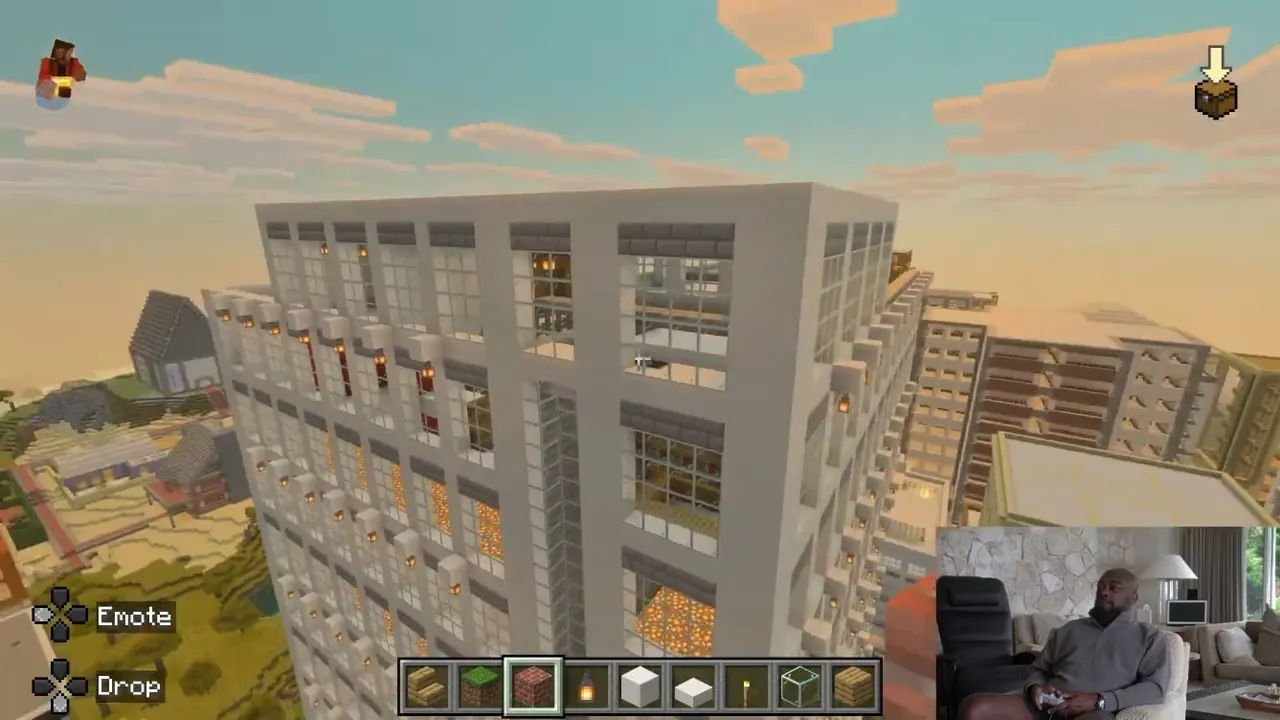
For twelve years, Mike Tomlin was building another city. He did this while coaching the Pittsburgh Steelers, which meant spending his working hours being held responsible for decisions made by very large men who remained legally entitled to make their own. Somewhere in the intervals, he went home and worked on a place where a thing stayed exactly where he put it.
The city exists in Minecraft, where Tomlin has recently begun offering walking tours of his municipal holdings. Players arrived and departed while he worked on them. His children grew older. Football seasons ended in the usual combination of explanations and accusations. Somewhere, a hotel needed finishing.
We are accustomed to hearing that coaches live and breathe football, a condition generally presented as admirable rather than something for which the family should arrange an intervention. Every available hour is supposed to disappear into preparation. If a coach admits to a second interest, someone will eventually identify a third-down conversion rate that might have improved had he loved his family less.
Tomlin, it turns out, had been attending to urban development.
We have all come home from work wishing fewer people had been involved in it. After nineteen seasons managing an NFL team, the appeal of a world with substantially fewer independent wills seems fairly accessible. You can explain an assignment to a person perfectly and still watch him do something else. A block offers a different professional relationship.
What makes the city worth examining is what Tomlin did with that authority. He built hotels and luxury residences, a baseball stadium and a soccer stadium, a bank and a pharmacy. The landscape gathers around a body of water. There are rooftops to visit, rooms to inspect, views somebody has considered. He appears to have given considerable thought to what it would be like to spend time there.
I had expected, perhaps unfairly, more conquest. Give an American football coach unlimited resources and I anticipate a fortress, an enormous weight room, possibly a mountain carved into the face of a respected defensive coordinator. Tomlin has a boutique hotel with a spa and a ballroom. His private civilization is prepared to accommodate your wedding.
This raises a more interesting question than whether the coach was wasting time. Why, after a working life organized around competition, does his imaginary world seem so concerned with hospitality?
He knows hotels. He knows the particular version of a city available to a professional football team: the arrival, the meeting room, the room upstairs, the appointed hour downstairs. He has spent years inside buildings intended to make complicated human movements proceed without incident. There is a whole American landscape designed to receive successful men, feed them predictably and put them within reasonable driving distance of their obligations.
Tomlin has built enough of it to suggest that some of those places stayed with him.
I began to wonder whether he had been collecting improvements. A room with a better view. A more agreeable roof. Lighting that didn’t make everyone look as though they had just received preliminary legal advice. Twelve years is ample time to encounter a hotel lobby and think, with the quiet conviction of a man who has somewhere else to put it, I can do better than this.
His attention to lighting is particularly persuasive. You can impose a building on a landscape fairly quickly when materials are unlimited. Making a room feel right requires you to stand in it for a while. It requires a kind of attention that produces very little anyone can measure. Nobody is going to ask how the lamps performed in December.
Naturally, I was suspicious of all this comfort. The luxury residences suggested that even a world without material scarcity had managed to develop a desirable end of town. There was a PNC Bank. Building materials could be summoned at will, yet someone had reserved premises for an institution whose business includes deciding whether you can afford a kitchen.
The CVS completed the neighborhood. A resident could descend from a penthouse containing anything the human mind could conceive and go downstairs for things he had forgotten to pack.
Tomlin’s city carried pieces of the world he knew into the world he controlled. Even the Trump Tower had brought its baggage: during the tour, he clarified that the building predated the first Trump presidency and should not be treated as an endorsement. He had invented an entire municipality and still found himself explaining the context of a decision.
There is an easy argument available here about the limits of American imagination. We give a man freedom from economics and he reproduces expensive housing, commercial banking and convenient access to mouthwash. I could develop that argument at considerable length. I had mentally set aside a paragraph for luxury’s dependence on exclusion.
Then he showed us the aquarium.
It extends through multiple rooms of a residence. Someone had to conceive of that, build around it, return to it and decide whether the fish were contributing adequately to the experience of being indoors. Tomlin was plainly pleased with it. I could find no useful public-policy objection to his pleasure.
This was inconvenient. I had been treating the city as evidence, and its creator appeared to have been treating it as something he liked.
The distinction becomes harder to ignore when you remember how it began. His children were playing Minecraft. He wanted to understand what held their attention, so he joined them. Over time, they moved on and he kept building. They helped preserve the city across successive PlayStations because he needed their technical assistance.
There is a whole family history tucked into that arrangement. The children introduce their father to a place, grow older, and periodically help him keep it. He continues making additions. A game they once played becomes something they make sure he doesn’t lose.
I cannot know what Tomlin was thinking about while he worked on any particular building. I would distrust anyone who claimed to read a playoff defeat in the placement of a staircase. But I find it moving that the project lasted long enough to become a constant while the circumstances around it changed. A season ends. A roster turns over. You still have a room you were meaning to finish.
For years, he could finish that room without us. He could decide the lighting was right without appearing before anyone on Monday to defend it. If something disappointed him, he could change it. If he liked it, that was sufficient reason to leave it alone. These are modest freedoms until you consider how much of his professional life was conducted without them.
I had mistaken complete control for an appetite for domination. Looking at what he made, I find myself considering a less impressive possibility: perhaps he wanted things to work. Perhaps he wanted somewhere pleasant to walk around, where the view was good and the small inconveniences could be corrected by the person who noticed them.
I still think the CVS is funny. I intend to continue thinking so. But an ordinary afternoon, with the necessities close by and nobody demanding an explanation, may be an ambitious enough fantasy for a man who spent nineteen seasons coaching professional football.
He has made something patient and unnecessary. I respect that more than I respect most things currently being described as visionary.
I would like to visit his city. I would like a room overlooking the water, a look at the aquarium, and no scheduled activities before lunch. At some point I would discover that I had forgotten my toothbrush.
The bastard has thought of everything.
 Brief
The Comments
0 ON THE RECORDPredictions and premature victory laps may inspire future coverage.