
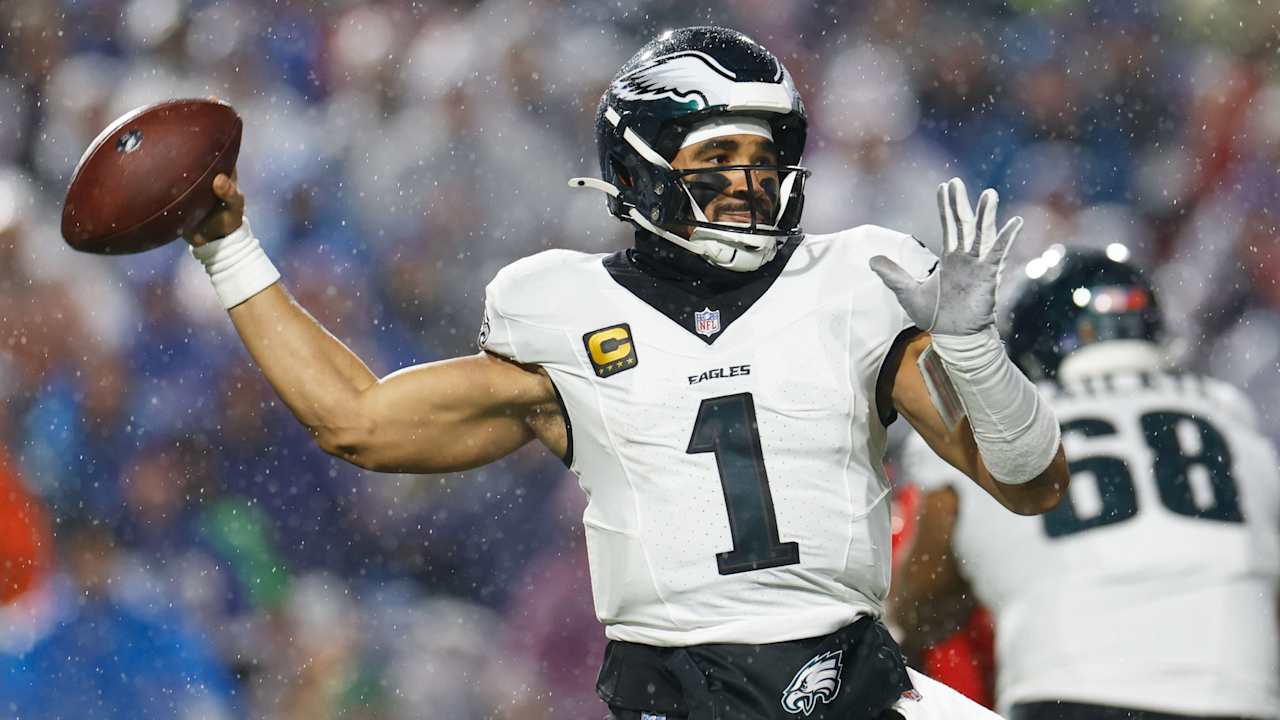
The Philadelphia Eagles employ doctors, athletic trainers, medical consultants, performance specialists and an entire professional infrastructure dedicated to maintaining the physical condition of their employees.
Somewhere within that apparatus, a group of highly qualified adults reportedly concluded that Jalen Hurts should not go to sleep.
Playing quarterback against the Jacksonville Jaguars, however, remained on the table.
According to NFL Network's Tom Pelissero, Hurts was advised by doctors in London to remain awake after a blood clot was discovered in his calf. By kickoff on October 11, he had reportedly gone approximately 36 hours without sleep.
He then played an entire NFL football game.
On Monday, the Eagles announced that further medical evaluations had revealed deep vein thrombosis and blood clots in both lungs. Hurts is expected to recover, but his season is over.
It would be comforting to regard the intervening football game as a misunderstanding. Unfortunately, the Eagles have already explained their reasoning.
In an October 15 statement, the organization said doctors determined that activity and mobility were important and that Hurts could safely play.
Activity and mobility.
These are reasonable objectives for a person recovering from certain vascular conditions. They are also an extraordinarily generous description of playing quarterback against eleven men being paid extraordinary sums of money to introduce him to the ground at considerable velocity.
One imagines the distinction between walking around a hospital corridor and absorbing a hit from an NFL defensive lineman might have warranted additional discussion.
And that is before considering the sleep deprivation.
Research published in Nature found that sustained wakefulness can produce measurable impairments comparable to alcohol intoxication. The CDC cites findings that performance after 24 hours awake can resemble that of someone with a blood alcohol concentration of 0.10 percent.
Hurts had reportedly been awake for another twelve hours beyond that benchmark.
Whether a man operating at the cognitive equivalent of legal intoxication was actually a better option than Tanner McKee remains an open question, although McKee's recent performances suggest Philadelphia's medical staff may not have been the only department confronting an unacceptable level of risk.
This also does not establish how impaired Hurts personally was. The research was not conducted on NFL quarterbacks. It does, however, establish that an absence of sleep is a physiological condition, not a testament to commitment.
The football industry has developed a remarkably durable habit of treating a player's willingness to perform as evidence that he should be permitted to do so.
Hurts was willing. Of course he was willing. He has spent his adult life being rewarded for precisely that quality. Playing through discomfort is not merely tolerated in professional football. It is celebrated, memorialized and periodically converted into advertising.
The entire purpose of employing medical professionals is to introduce a competing interest.
There is a meaningful difference between saying Hurts wanted to play and establishing that playing was a responsible decision. The latter belongs to people whose judgment is supposed to remain intact even when a franchise quarterback insists he is fine.
Professional athletes are adults, entitled to make consequential decisions about their own bodies. But the right to accept personal risk is not quite the same as the authority to determine whether an employer should expose you to it. An NFL player can decline to play. It does not follow that he should be able to overrule a medical professional who believes he cannot safely participate.
The conflict is not difficult to identify. The player wants to compete. The coach wants to win. The organization has a substantial financial interest in keeping its franchise quarterback healthy for years to come, but also an immediate interest in winning Sunday's football game. Those objectives generally coexist peacefully until protecting the long-term investment requires sacrificing the short-term result.
That is precisely when independent medical judgment is supposed to matter.
But independence is not merely a matter of placing a doctor in the room. It requires an institution willing to accept an answer that is inconvenient to everyone else in it.
Whether the Eagles' medical staff violated an accepted standard of care remains an open question. The precise clinical reasoning behind the instruction to stay awake has not been made public, and the later diagnosis does not, by itself, prove the original clearance was negligent.
But the sequence deserves independent scrutiny, particularly now that the consequences have become much more serious.
The Eagles have emphasized that Hurts's health and safety are their highest priority.
That is reassuring. It would have been useful to know where they ranked during the 36 hours when he was apparently not permitted to sleep, the football game he was subsequently allowed to play, and the transatlantic flight home.
For all the sophistication of modern professional sports science and medicine, the threshold for 'good enough to go' still seems far too dependent on an athlete's word and the criticality of the matchup.
Had the Eagles entered the game 2–4 rather than leaving it as such, it's reasonable to wonder if they might have prioritized letting Hurts get some sleep.
Perhaps the next medical consultation should begin with a simpler question.
Would we allow this man to drive himself to the stadium?
 Brief
The Comments
0 ON THE RECORDPredictions and premature victory laps may inspire future coverage.